Skunk Currant
Ribes glandulosum
Grossulariaceae

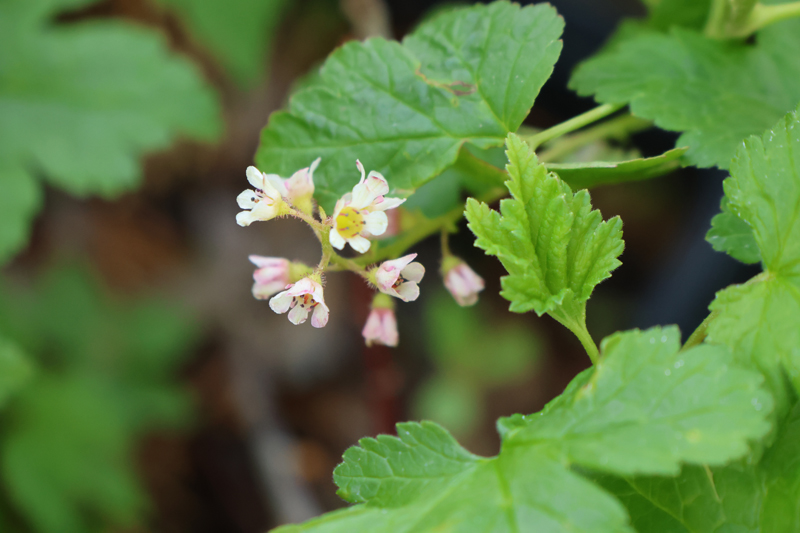
A very petite fruit-bearing shrub of habitat edges, Skunk Currant is both very cute and a little bit odd. Flowers (May-June) are white and pink, showy, and turn increasingly purple with age before becoming small edible berries covered with delicate glandular hair (they start out green and turn red when ripe). Leaves are attractive, shallowly lobed, and often have a slight purple tinge around the edges or along the leaf stalk. Tolerates rocky or shallow soil, acid conditions, wetland conditions, sand, talus/rocky slopes, occasional flooding, bogs, and deep shade (although it prefers at least dappled conditions). Tends to sprawl a bit and may tip-root where it rests on the ground. Host plant for one of our favorite summer visitors, the Grey Comma Butterfly (Polygonia progne), and supports native pollinators, especially bees. The edible berries are also a great source of food for wildlife! This little plant is named for the somewhat rank scent it produces when the leaves are bruised and when the berries become overripe-when we first encountered it in the wild growing atop a large flat rock in Maine, we were a little bit flummoxed by what that odd smell was after we'd been looking at the leaves ... needless to say we cleared up that confusion pretty quickly once we finished identifying it and learned what it was called! This species also has a somewhat interesting history-starting in the early 1900s after the introduction of White Pine Blister Rust to the US, efforts were started to eradicate and control all Ribes species in the US (including native ones!) to protect White Pine trees. These efforts failed to take into account the role of native Ribes species in the natural ecosystem and luckily these efforts were not successful (although the sale of Ribes is still prohibited in a number of states, and the bias against them is still ongoing; it's still illegal to import Ribes to the US!). Over 100 years since the introduction of the fungus however, White Pines still thrive across the country, and Ribes still quietly grows in the woods, neither of them eradicated and both of them still providing their own ecological services and natural beauty.


2-3 feet tall
Plant Hardiness Zones:
Zone 2a-7b
Woody Shrub or Tree
Native Range: ME south to NC and TN, west to MI. Also along the northern border through WI and MN. Native to Canada in BC, AB, SK, MB, ON, QC, NB, PE, and NS. Rare in CT, NJ, VA, and TN. Considered extirpated in OH.
Germination - Easy: : Cold stratify 8 weeks.
Review or Finalize Your Order